How I Started Writing About Email Sign-offs and Ended Up Releasing Old Emotional Baggage
This morning I came downstairs in a good mood. I sat down and started writing an article about closing phrases in written communication. I reflected on how my own use of expressions like Yours sincerely, kind regards, best and much love has changed over the last decades – and how there is still a cultural difference between Germany, Scandinavia and the US in using them.
From “Yours Sincerely” to “Much Love” – A Personal Journey Through Email Sign-offs
I reflected on why my closings got much warmer over the years. How much of this might be conditioning from a family that did not love bomb each other in their communication – and from growing up in a far more hierarchical world, with more formalities, in the 1970s, when hugging your friends goodbye was not nearly as common.
I looked at different communication tools: letters, then email, and later texting. All of them shifted the way we communicate and say hi and goodbye in written form.
I remembered how Liebe Grüße – similar to warm regards in English – entered university communication and later even business emails. And how I nowadays end a lot of written communication with much love, something I could not have done authentically ten years ago.
The Shift From Formal Relationship Encoding to Emotional Signaling
I wondered whether this was related to the dominant group I communicate with – more spiritual people – but came to the conclusion that there had also been a broader shift: from formal relationship encoding to emotional atmosphere signaling in sign-offs. Writing much love at the end of an email signals friendly intention more than it defines the relationship to the person you are writing to. Whilst in earlier days it was clear that you would only use the word love for people you were already in a close relationship with.
When Writing Makes You Grumpy – The Unexpected Emotional Trigger
Whilst writing this article I suddenly became very tired and moody, kind of annoyed. I had not had a real breakfast yet, so I decided to take a break and eat. But this did not help. So I started looking back at when exactly this mood shift had happened.
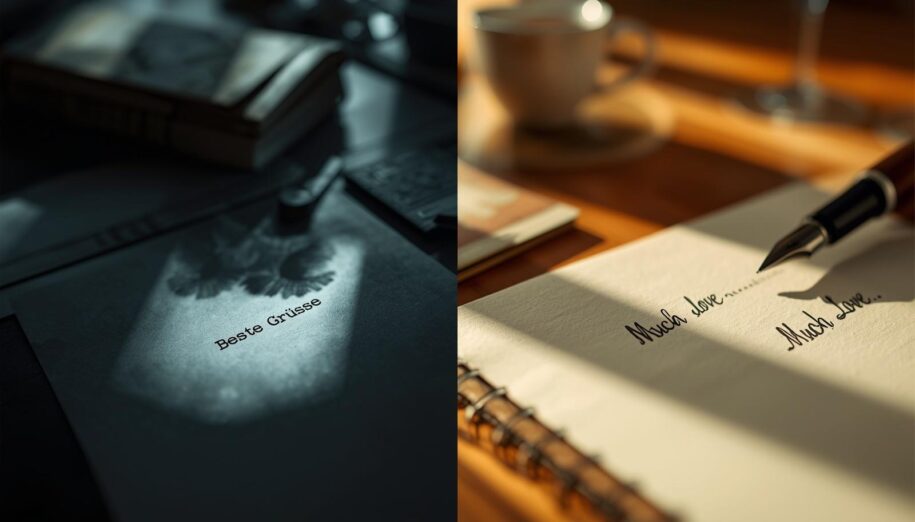
It was striking that I had been writing about a lot of German endings, including the formal ones. And there they were – the memories, the old stories attached to formal communication: lawyers, institutions and everything else I had to struggle with in the past. I had not even consciously thought about those letters whilst writing, but it seemed enough that formal endings like Beste Grüße (kind regards) triggered the connection to the times when those letters hung like a dark cloud over my life.
This was kind of shocking to me. How little of a trace – just an old memory surfacing unconsciously through a closing phrase – could take you from feeling really good and peaceful to annoyed and grumpy.
Grabbing the Toolbox – EFT Tapping and Intention Tapping to Release Emotional Triggers
Luckily I love the Sherlock part of the energetic work I do. I tested my assumptions and got confirmation that this was exactly what I was dealing with. Then I grabbed my toolbox and did some EFT Tapping as well as Intention Tapping to release the emotional attachments to those letters, their content, the connection to formal sign-offs, and the mood I had switched into.
And boom – after a few minutes the tiredness was gone, my mood lifted and I sat down and rewrote the article into this piece.
Was It Intuition All Along?
I am still wondering whether the reason I started writing the other article came purely from intuition – a quiet nudge to release certain emotional imprints – or whether I really just wanted to understand my own use of sign-offs in emails better.
Maybe both.
Anyhow, I am closing this article with
much love,
Nadja
If you are interested in booking a Sherlock Session with me to release some emotional triggers in your life, feel free to write me at info@nadjafranz.com